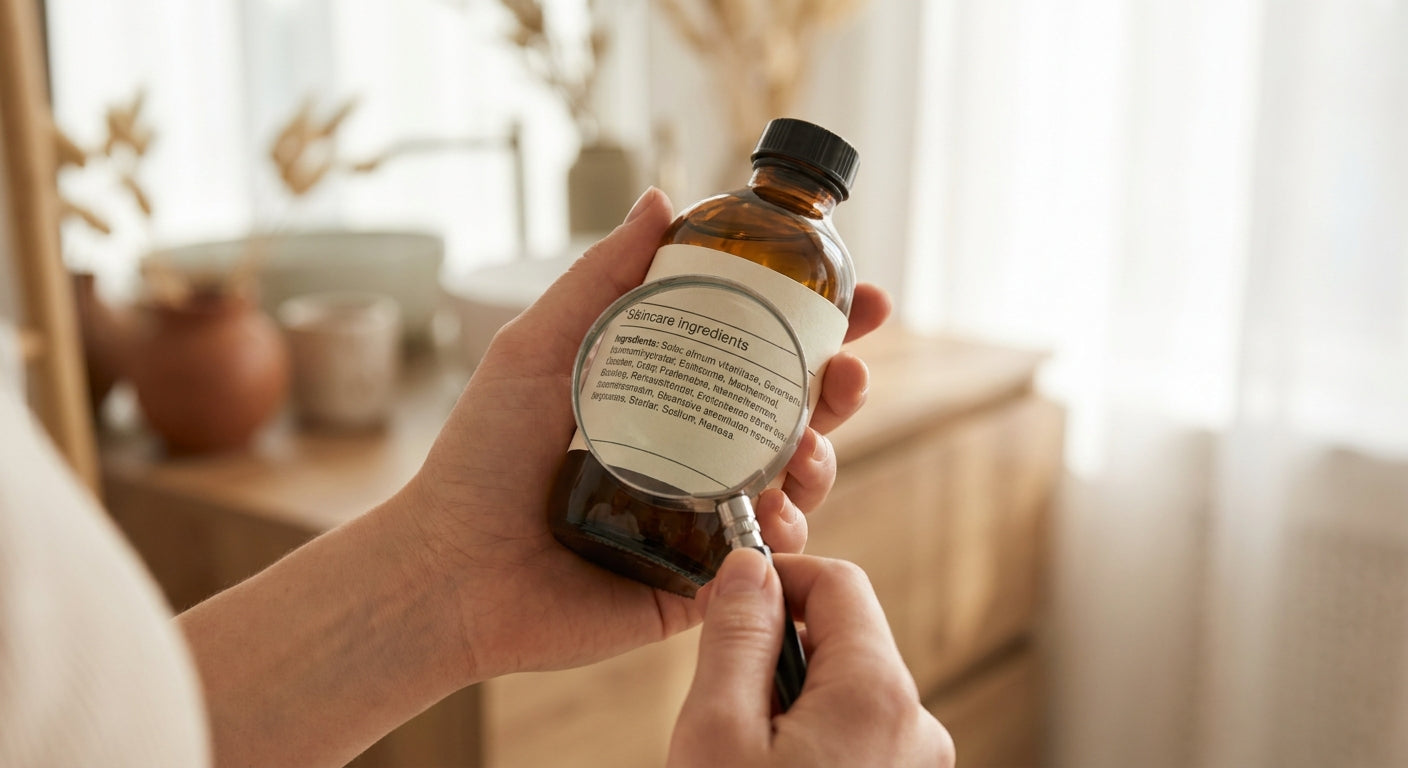
Reading a skincare label takes less than a minute once you know the order ingredients have to follow and which words on the front of the bottle carry no legal weight at all. This guide breaks down how to read a skincare label the way someone who checks the INCI first would — line by line, term by term, no guessing.
- Reading a skincare label starts with the INCI list — the front of the bottle is marketing, not proof.
- Ingredients are ranked by concentration; anything past position 10-12 on a short list is usually a trace amount.
- COSMOS NATURAL audits ingredient origin and extraction through a third party — 'natural' alone has no legal meaning in the US.
- 'Parfum' or 'Fragrance' as one line can hide dozens of unlisted compounds — check for it if your skin reacts easily.
- Read the INCI, check the certification, don't take the front label's word for it. That's the whole method.
Why this matters
Front-of-bottle claims are unregulated copy. "Brightening," "renewing," "dermatologist-loved" — none of it has to match what's actually in the bottle. The ingredient list, printed in International Nomenclature of Cosmetic Ingredients (INCI) format, is the one part of a skincare label that's actually accountable to something.
Most men skip it entirely. That's the gap. Learning to read a skincare label in 2026 takes about five minutes the first time, and it works on every product you pick up after that — not just the ones already on your shelf.
What you'll need
- One product with a published origin story to check the method against. All-In-One Facial Oil lists cold-pressed jojoba, rosehip, and sea-buckthorn by name and region, which makes it a clean example of a label that backs up what it claims.
- The actual product in hand, or its ingredient list pulled up on the product page.
- A phone, to look up an unfamiliar ingredient name or a certification body in under 10 seconds.
- Two minutes, uninterrupted. Most labels take 60-90 seconds to read properly once you know the order.
The steps
1. Skip the front of the bottle, go straight to the ingredient list
The hero claim on the front — "brightening," "anti-aging," "for men" — is copy, not a fact you can check. The INCI list, usually printed small on the back or base of the bottle, is the part with an actual naming standard behind it.
Turn the bottle over and find the block of ingredient names, usually starting with Aqua (water). That's your starting point for everything else in this guide. Common mistake: reading the front claim and assuming it describes the formula. It describes the marketing budget.
2. Read the list in order — position ranks concentration, not importance
By law, ingredients present above 1% concentration have to be listed in descending order. Ingredient #1 is almost always water. Positions #2 and #3 tell you what the formula is actually built around — not the name on the box.
If the active you're paying for sits at position 12 or later on a list of 15, it's present at a low enough dose that it's there for the label, not the result. Common mistake: assuming a product named after an ingredient (a "vitamin C serum") automatically has that ingredient dosed high.
“If the active you're paying for isn't in the first five or six positions, the front label did more work than the formula did.”
3. Name the actives, then check what each one actually claims to do
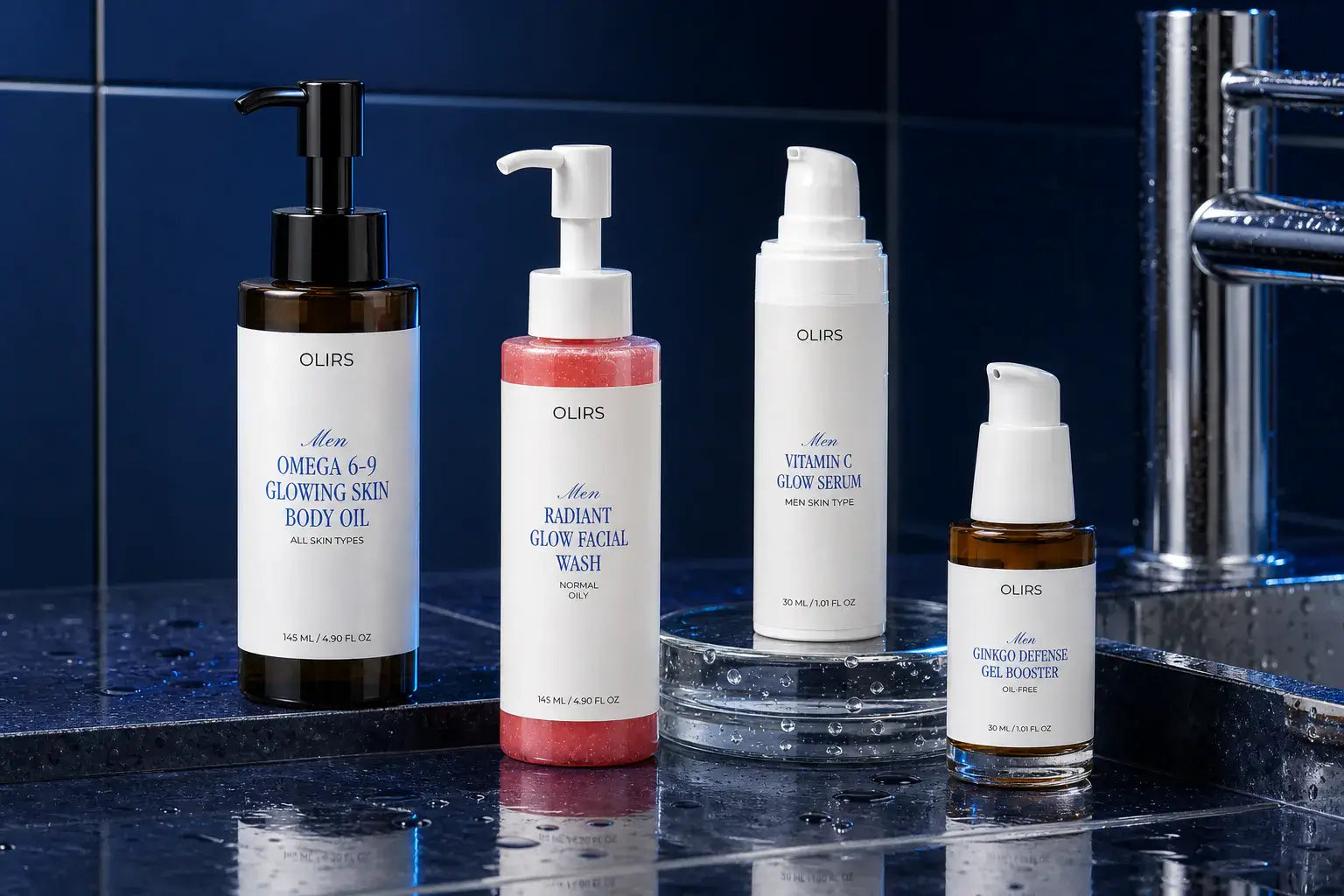
Once you've found the actives, match each one to a plain-language function — not an adjective. Stabilised vitamin C paired with ferulic acid is one pattern worth recognising; it's the combination behind products like Vitamin C Glow Serum, where vitamin C sits high enough in the list to be doing the antioxidant work the name promises.
Use appearance language to judge the claim: "helps skin look more even" is checkable against what's in the bottle. "Fixes" or "cures" isn't a claim any formula — from any brand — is allowed to make. Common mistake: trusting a product because it uses a trend word (peptides, bakuchiol, niacinamide) without checking where that word sits in the list.
4. Check the certification marks and confirm what they actually cover
A certification logo means a third party audited something specific. COSMOS NATURAL, for example, means an outside body — Ecocert, in most cases — checked the ingredient sourcing and extraction method, not just the finished bottle. That's different from a brand simply printing "natural" on the front, which in 2026 still isn't a regulated word in the US.
Origin claims are worth the same scrutiny. Products with a documented sourcing chain — jojoba, rosehip, and sea-buckthorn traced to specific regions, or the shea, argan, and jojoba in Gentle Cleansing Milk, where the argan is sourced from Morocco's UNESCO-designated argan biosphere reserve — can name the region and the pressing method. Most products on most shelves can't, and that's worth noticing. Common mistake: treating any logo as equally verified. Look up the certifying body's registry if the claim matters to your decision.
5. Flag the words that carry no legal weight on their own
"Clean," "natural," "dermatologist tested," "hypoallergenic" — none of these are enforced by a regulatory body in the US the way "COSMOS NATURAL" or "USDA Organic" are. "Clean" describes a formula at best, and even then it means nothing without a certification standing behind it.
These words aren't dishonest by default. They're just unverifiable on their own. Common mistake: picking a product because the front of the bottle used one flattering word instead of checking whether a real standard sits behind it.
6. Check the fragrance and preservative lines, especially if your skin reacts easily
"Parfum" or "Fragrance" as a single line item is a legal catch-all that can hide dozens of individual compounds a manufacturer isn't required to disclose separately. If your skin has flagged a reaction before, that one word is worth more attention than almost anything else on the label.
Look for an explicit "fragrance-free" claim, and separately check whether common irritant compounds — linalool, limonene, citral — are listed even inside an essential-oil blend. Common mistake: assuming "natural fragrance" is automatically gentler than a synthetic one. Essential oils are common irritants too.
7. Verify a claim before you build a routine around it
If a product or a post cites a study, check the year and the journal before treating the number as settled. A cited figure is only proof until someone checks it against the primary paper and finds it was misread — then it's the only thing anyone remembers.
This habit takes 30 seconds on a phone: search the ingredient name plus "study," note the publication year, and see if the claim on the label matches what the study actually measured. Common mistake: trusting a number because it sounds specific. Specific and sourced aren't the same thing.


Troubleshooting
- The ingredient name is 20 letters long and unpronounceable. Length isn't a proxy for safety — it's chemical naming convention. Check position on the list instead of pronunciation.
- The list is in a different language than expected. INCI names are standardized in Latin/English-based nomenclature across most markets, so "Aqua" reads the same on a bottle shipped anywhere in 2026.
- The certification logo has no license or registration number printed. Treat it as unverifiable until you can confirm it against the certifying body's own registry.
- The front label promises visible results but the ingredient list looks thin. That mismatch is the single biggest tell that marketing is outpacing the formula.
- You can't find where fragrance sits in the list. If "Parfum" isn't listed at all, check for an explicit "fragrance-free" claim rather than assuming its absence means anything.
- Two products claim the same active at very different prices. Compare position on the list and stated concentration, not the price tag, before deciding which one is actually formulated around it.
Tools and resources
- The product's own listing page — full INCI order should be published there, not just on the physical label.
- The certifying body's public registry (Ecocert for COSMOS NATURAL) to confirm a license number is real.
- A search engine, for checking a cited study's year and journal before trusting a number.
- A short list of the marketing words worth flagging: clean, natural, hypoallergenic, dermatologist tested — none regulated on their own in the US as of 2026.
What to do next
Once the label makes sense, the next problem is usually routine order — what goes on first, and how many steps actually earn a place in a real morning. A simple skincare routine for men who hate fuss covers that build without adding steps you won't keep up in 2026.
FAQ
What's the best way to read a skincare label in 2026?
Start with the INCI list, not the front-of-bottle claim, and check ingredient order since position ranks concentration by law. Then confirm any certification logo against the certifying body's public registry before trusting it.
Is 'natural' the same as 'organic' on a label?
No — they're separate claims with separate standards. COSMOS NATURAL audits ingredient origin and extraction; COSMOS ORGANIC requires a higher threshold of certified-organic content and is a distinct certification.
How much fragrance is normal in a men's skincare product?
There's no fixed amount, since 'Parfum' or 'Fragrance' is listed as a single catch-all line that can hide dozens of compounds. If your skin reacts easily, look for an explicit fragrance-free claim instead of estimating from the ingredient list alone.
What does COSMOS NATURAL certification actually verify?
It means a third-party body, typically Ecocert, audited ingredient sourcing and extraction methods, not just the finished formula. It's a mechanism with a real cost to obtain, not a self-declared word like 'clean.'
Is a longer ingredient list worse than a short one?
Not by itself. Length says nothing about safety or effectiveness — what matters is where your active ingredients sit in the order, since position reflects concentration.
How do I know if an active ingredient is dosed high enough to work?
Check its position on the INCI list. Ingredients above roughly position 10-12 on a typical list are usually present at meaningful concentrations; further down, they're often trace amounts included for the label.
What ingredients should I avoid if my skin reacts to fragrance?
Look for 'fragrance-free' stated explicitly, and check for named irritant compounds like linalool, limonene, and citral even inside essential-oil blends, since natural fragrance sources can irritate skin too.
One last thing
Ingredients under 1% concentration can legally be listed in any order once the list drops below that threshold — which means the back third of most labels tells you almost nothing about actual dose. Read the front half carefully. The back half is mostly preservatives, pH adjusters, and fractions of a percent.